Roth vs Traditional 401k: What Each Costs Per Paycheck
Roth vs traditional 401k, priced per paycheck: see what a 5% deferral costs on a $60,000 salary, why Roth takes more today, and why FICA never changes.
By the PayCalculatorUSA.com team
Roth vs traditional 401k changes what your contribution costs this payday, not what lands in the retirement account. A Roth deferral comes out after federal income tax is worked out, so it cuts your take-home pay by the full amount, while a traditional deferral of the same size costs less today because it lowers your federal withholding first.
Put 5% of a $60,000 salary into either one and the plan gets the same $115.38 a check. The Roth version just costs you $13.85 more in spending money now.
Traditional and Roth: the one stub line that changes
Payroll runs in a fixed order. Gross pay first, then pre-tax deductions, then withholding on whatever is left.
A traditional deferral sits in the pre-tax deduction group, so it shrinks the wage figure your employer runs through the federal tables. A Roth deferral sits after that step, so the tables never see it. Same plan, same 401(k) rules on limits and vesting, different spot in the math.
Neither one touches FICA. Social Security and Medicare are figured on your full gross pay before any retirement line comes out.
Where each line lands on the pay stub
Roth money usually shows as its own line, labeled something like “Roth 401(k)” beside or instead of the regular 401(k) line.
The box to check is taxable wages. A traditional contribution pulls that number below your gross pay. A Roth contribution leaves it alone. The short answer on whether a 401(k) reduces taxable income only applies to the traditional side.
What each choice costs you this payday
Start from the standard example: a single filer earning $60,000 a year, paid every two weeks, standard W-4, no pre-tax deductions. Gross pay is $2,307.69 a check. Federal withholding is $193.08. FICA is $176.54, made up of $143.08 of Social Security and $33.46 of Medicare. Before state tax, that leaves $1,938.07.
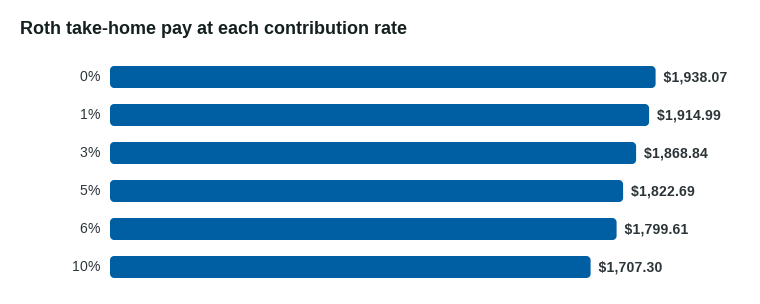

A $60,000 salary with the standard deduction puts a single filer in the 12% federal bracket, so each pre-tax dollar trims federal withholding by about 12 cents. That 12 cents is the whole difference between the two choices.
| Rate | Into the plan | Traditional take-home | Roth take-home | Roth costs extra |
|---|---|---|---|---|
| 0% | $0 | $1,938.07 | $1,938.07 | none |
| 1% | $23.08 | $1,917.76 | $1,914.99 | $2.77 |
| 3% | $69.23 | $1,877.15 | $1,868.84 | $8.31 |
| 5% | $115.38 | $1,836.54 | $1,822.69 | $13.85 |
| 6% | $138.46 | $1,816.23 | $1,799.61 | $16.62 |
| 10% | $230.77 | $1,734.99 | $1,707.30 | $27.69 |
At 6% of pay, a common level, both choices send $138.46 to the plan. Traditional costs $121.84 of take-home. Roth costs the entire $138.46. The $16.62 gap works out to about $432 over 26 checks.
Notice the gap grows with your bracket, not just your rate. In the 22% bracket, the same 5% Roth contribution costs roughly $25 more per check than traditional, because there is more withholding for pre-tax money to shave off.
Those figures cover federal withholding and FICA only. In almost every state, a traditional contribution lowers state withholding too and a Roth one does not, which widens the real gap a little. The California paycheck calculator shows that state line, and Pennsylvania is the one state where a traditional deferral does not cut state tax either. For a breakdown of every other line on the same check, see how much is taken out of a paycheck for taxes.
The tax bill you move to later
Roth pays the tax now at today’s rate. Traditional pays it on withdrawal at whatever your rate is then.
Qualified Roth withdrawals come out free of federal income tax, including investment growth, once you are past 59 and a half and the account has been open five years. Traditional withdrawals count as ordinary income in the year you take them. The IRS Roth comparison chart lays out both sets of rules side by side, and Wikipedia’s Roth 401(k)) article covers the account’s history.
So the $13.85 is not a fee. It is tax you are choosing to pay at a rate you know instead of a rate you do not. Nobody can tell you future rates, which is why this is a judgment call and not a calculation.
How employer matching is treated
Your choice does not change the match. If a plan matches a percentage of pay, it looks at how much you deferred, not which bucket you sent it to.
Match money never shows in net pay. It is not part of gross pay, so it is not taxed on the check it lands on, and your stub may show it only as an informational line.
Matched dollars have usually gone into a pre-tax bucket taxed at withdrawal, even when your own contributions are Roth. Some plans now offer a Roth match election, which makes the matched amount taxable income in the year you receive it. Match formulas and options vary a lot, so read your plan document rather than assuming.
Splitting between both, or switching mid-year
Most plans let you set two percentages at once. Put 3% in each on this salary and $69.23 goes to each bucket, $138.46 total, for $130.15 of lost take-home.
Both types share one yearly elective deferral limit. Splitting changes the tax treatment of your savings, not the ceiling on them.
Switching mid-year only affects future checks. Contributions already withheld keep the treatment they had when they came out, and the first check after the change is where your net pay moves.
Picking the one that fits your current withholding
- If your check already feels tight, traditional buys the same retirement balance for less cash today.
- If you are early in your career and expect a higher bracket later, Roth locks in today’s lower rate.
- If you have no idea which way rates go, split and stop worrying about it.
- If what you actually want is lower payroll tax, neither works. An HSA through payroll cuts FICA wages; a 401(k) never does.
- If you want to save more without another cut to take-home, raise the traditional percentage first and watch withholding absorb part of it.
The guide on what a 1% contribution costs your paycheck walks through the traditional side at more rates, including how pre-tax money changes your withholding line.

Run it on your own check
Plug your real salary, pay frequency and state into the Salary Paycheck Calculator on the paycheck calculator home page. Enter your contribution as a pre-tax deduction to see the traditional cost, then take it back out and subtract the same dollar amount yourself to see the Roth cost. The difference you see is your own bracket at work.
Frequently asked questions
Does a Roth 401(k) lower my paycheck more than a traditional one?
Yes. A Roth contribution comes out after federal income tax is figured, so it cuts take-home pay by the full amount you defer. A traditional contribution of the same size lowers your taxable wages first, so part of the cost is covered by smaller withholding. On a $60,000 salary, a 5% Roth deferral costs about $13.85 more per biweekly check.
What does a Roth 401(k) contribution cost per paycheck?
The full contribution. On $60,000 paid every two weeks, gross pay is $2,307.69 and take-home before state tax is $1,938.07. A 5% Roth deferral sends $115.38 to the plan and drops take-home to $1,822.69. The same 5% traditional deferral leaves $1,836.54, because federal withholding falls by $13.85.
Does a Roth 401(k) reduce taxable income?
No. Roth money is taken from pay that has already been counted for federal income tax, so your taxable wages on the stub stay the same and your withholding does not change. Only traditional contributions lower taxable wages. The trade is that qualified Roth withdrawals, including growth, come out tax free later under the plan's rules.
Does picking Roth change my Social Security and Medicare tax?
No. FICA is figured on your full gross pay before any 401(k) line comes out, so Social Security stays $143.08 and Medicare stays $33.46 on a $2,307.69 check under either choice. No contribution rate and no W-4 change moves those two lines. An HSA or FSA through payroll does cut FICA wages.
Can I contribute to both a Roth and a traditional 401(k)?
In most plans, yes. You set two percentages and your employer splits each check between the two buckets. Both share one yearly elective deferral limit, so the split decides the tax treatment, not how much you can save. You can also switch mid-year, which changes future checks only.