Why Is W-2 Box 1 Lower Than My Salary? Reconciling Pay Stubs and Your W-2
Why is W-2 Box 1 lower than my salary? Pre-tax 401(k) and health deductions. See a $60,000 example, how Box 1, 3 and 5 differ, and how to check your last stub.
By the PayCalculatorUSA.com team
Why is W-2 Box 1 lower than my salary? Because Box 1 reports taxable wages rather than your hiring rate, and every dollar routed through payroll into a traditional 401(k), a health premium, an FSA or an HSA comes out before that number is printed. A $60,000 job can show $53,800 in Box 1 and be perfectly correct.

If the order those deductions come out in is still fuzzy, the walkthrough of how to calculate take-home pay from gross pay covers one paycheck step by step. This page picks up where the pay stub ends and the form begins.
What Box 1 of Form W-2 actually reports
Box 1 is labeled “wages, tips, other compensation.” It is the figure that carries over to your Form 1040 as wage income, and nothing else on the form plays that role.
It is your pay plus taxable extras, minus pre-tax subtractions:
- plus bonuses, commission, overtime, cashed-out leave and imputed income such as employer-paid group life above $50,000 of coverage
- minus traditional 401(k), 403(b) and 457 deferrals
- minus cafeteria plan premiums for health, dental and vision
- minus health FSA, dependent care FSA and payroll HSA contributions
Form W-2 reports taxable wages separately for income tax, Social Security and Medicare. Those three taxes do not share one definition of wages, so the boxes disagree on purpose. The IRS description of Form W-2 lists what belongs in each one.
Pre-tax deductions that shrink Box 1
Start with the standard example used across this site: a single filer earning $60,000 a year, paid every two weeks, $2,307.69 gross per check, standard W-4. With no pre-tax deductions, federal withholding runs $193.08 a check and FICA runs $176.54, split into $143.08 of Social Security and $33.46 of Medicare. Box 1 would read $60,000.
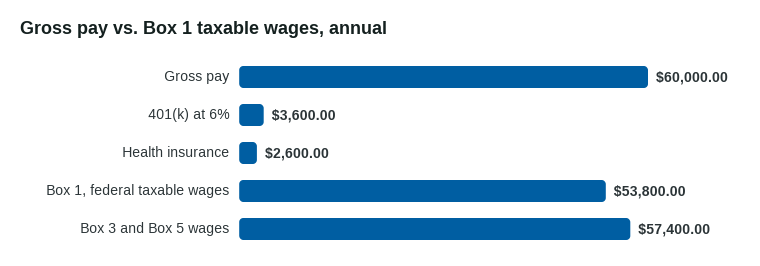
Now give that same worker 6% into a traditional 401(k) and $100 a check for health insurance.
| Line | Per paycheck | For the year |
|---|---|---|
| Gross pay | $2,307.69 | $60,000.00 |
| 401(k) at 6% | $138.46 | $3,600.00 |
| Health insurance | $100.00 | $2,600.00 |
| Box 1, federal taxable wages | $2,069.23 | $53,800.00 |
| Box 3 and Box 5 wages | $2,207.69 | $57,400.00 |
Six thousand two hundred dollars of deductions, and Box 1 lands exactly $6,200 under the salary. The money is not missing. It went into your retirement account and your insurance, and the guide on pre-tax deductions and 401(k) contributions shows how each type behaves.
Why Box 3 and Box 5 come out higher
Box 3 is Social Security wages. Box 5 is Medicare wages. A traditional 401(k) deferral lowers income tax wages but not these two, so both boxes sit above Box 1 by whatever you deferred.
In the example, Box 3 and Box 5 both read $57,400. The $2,600 of health premiums came out of all three boxes. The $3,600 of 401(k) money came out of Box 1 only.
From there the tax boxes follow: Box 4 is 6.2% of $57,400, or $3,558.80, and Box 6 is 1.45% of $57,400, or $832.30.
When Box 3 stops climbing
Social Security applies only up to a yearly wage base, currently $184,500 of wages. Past that point Box 3 freezes at the wage base while Box 5 keeps rising, because Medicare has no cap. An extra 0.9% Medicare tax also kicks in once a single employer has paid you more than $200,000.
So a high earner can hold three different wage figures on one form, all accurate.
Checking your final pay stub against your W-2
Pull the last stub of the year and work down the year-to-date column:

- Note year-to-date gross earnings.
- Subtract year-to-date 401(k), medical, dental, vision, FSA and HSA amounts. The result should equal Box 1.
- Add the 401(k) back. That should equal Box 3 and Box 5, with Box 3 capped at the wage base.
- Year-to-date federal income tax should equal Box 2, Social Security should equal Box 4, Medicare should equal Box 6.
- State income tax should equal Box 17, and state wages should equal Box 16.
- Read Box 12. Code D is your traditional 401(k), AA is Roth, W is HSA money, and DD is the cost of your health coverage, which is informational and taxes nothing.
With the deductions above, per-check federal withholding falls to $164.46, so Box 2 reads about $4,276 rather than $5,020. If you want the stub itself decoded first, see gross pay vs net pay.
Box 16 often matches Box 1 because most states start from federal taxable wages. California is one state that does not follow the federal HSA rules, so HSA contributions get added back there.
Common causes of a real mismatch and how to get a W-2c
Most gaps have a plain explanation:
- a final check paid in January, since wages count in the year they are paid
- third-party sick pay reported by the insurer
- imputed income for group life or domestic partner coverage, often loaded in December
- a payroll provider change mid-year, which can produce two W-2s that have to be added together
- a wrong name or Social Security number, which breaks matching even when the dollars are right
If the numbers still do not reconcile, ask your payroll department for a corrected form, Form W-2c. Employers can issue one at any point. The IRS page on an incorrect or missing W-2 explains what to do if your employer will not fix it, including filing Form 4852 as a substitute. Keep your final stub either way, because it is the evidence.
What a lower Box 1 means for the tax you owe
A smaller Box 1 means less income tax, not a smaller paycheck that vanished. In the example, taxable income drops from $43,900 to $37,700 after the $16,100 standard deduction, so federal income tax falls from about $5,020 to about $4,276. That is $744 saved, which is 12% of the $6,200, matching the bracket those dollars sat in.
Social Security and Medicare do not budge. The 401(k) money still paid FICA, which is why Box 3 and Box 5 stayed at $57,400.
Lower Box 1 also lowers your effective tax rate for the year, which can be a surprise if you expected the number from your bracket. For a wider list of what comes out between salary and bank deposit, see every deduction explained.
Check the figures yourself
To rebuild Box 1 from scratch, enter your salary, pay frequency, state and pre-tax deductions into the free paycheck calculator on the PayCalculatorUSA home page. Multiply its taxable wage figure by your number of pay periods and compare it to the form in front of you.
Frequently asked questions
Does Box 1 include my 401(k) contributions?
Traditional 401(k) money is left out of Box 1, which is why Box 1 can sit thousands below your salary. Those same dollars stay inside Box 3 and Box 5 because Social Security and Medicare still apply to them. Roth 401(k) contributions work the opposite way. They are after tax, so they stay in all three boxes.
Should Box 1 match the salary in my offer letter?
Rarely. An offer letter states a yearly rate, while Box 1 reports what was actually paid to you and taxed during the calendar year, after pre-tax deductions. A mid-year start, a raise, unpaid leave, a bonus or a final check that landed in January all move Box 1 away from the offer letter figure.
Is Box 16 always the same as Box 1?
Usually close, but not guaranteed. Most states begin with federal taxable wages, so Box 16 often equals Box 1. Some states do not follow the federal treatment of health savings accounts, California among them, so HSA money gets added back to state wages. States with no wage income tax may leave Box 16 blank.
What if Box 1 is higher than my salary?
That points to taxable extras rather than an error. Bonuses, commission, overtime, cashed-out paid time off, employer-paid group life coverage above $50,000, personal use of a company car and taxable gift cards all get added to Box 1. Compare the year-to-date earnings section of your last pay stub line by line before asking payroll to look at it.