Why Was My Bonus Taxed So High? Withholding vs the Tax You Owe
Why was my bonus taxed so high? Because 22% flat federal withholding, FICA and state tax stack up. See what comes back at filing and how to adjust your W-4.
By the PayCalculatorUSA.com team
Why was my bonus taxed so high? Your employer most likely withheld a flat 22% of it for federal income tax, then took 7.65% for Social Security and Medicare, then a state rate on top, which together can reach nearly 40% of the payment. None of that is your final tax bill. It is a deposit against the tax you owe for the year, and in the middle brackets a good share of it comes back as a refund.
Why the bonus looked like it was taxed at a higher rate
A bonus counts as a supplemental wage rather than regular pay. That lets your employer use the flat rate method: 22% of the payment for federal income tax, with no W-4 math and no brackets involved. Payroll systems do this by default because it is simple and it is allowed under IRS Publication 15.
Then the normal payroll taxes apply, because a bonus is still wages. Social Security takes 6.2% and Medicare takes 1.45%.
State withholding lands last. California publishes a supplemental rate of 10.23% for bonuses and stock options, above the 6.6% it applies to other supplemental pay.
Add them up: 22% plus 7.65% plus 10.23% is 39.88%. That is where “my bonus was taxed at 40 percent” comes from. A sign-on bonus gets the same treatment, which is why a new hire’s first big check often lands lighter than expected.
What a $5,000 bonus looks like on the standard example
Take the standard example used across this site: a single filer earning $60,000 a year in California, paid every two weeks, standard W-4, no pre-tax deductions. A regular check is $2,307.69 gross, with $193.08 of federal withholding and $176.54 of FICA, split into $143.08 of Social Security and $33.46 of Medicare.
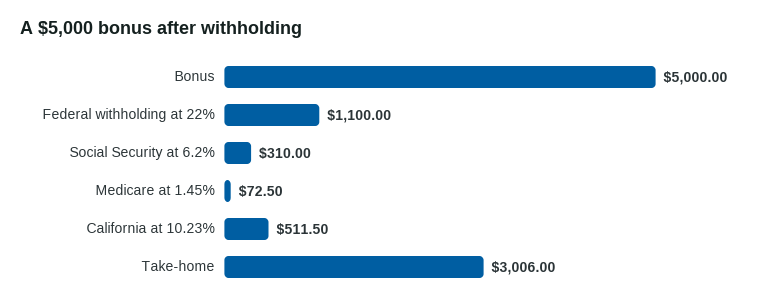
Now add a separate $5,000 bonus check.
| Line | Amount |
|---|---|
| Bonus | $5,000.00 |
| Federal withholding at 22% | $1,100.00 |
| Social Security at 6.2% | $310.00 |
| Medicare at 1.45% | $72.50 |
| California at 10.23% | $511.50 |
| Take-home | $3,006.00 |
That is $1,994 held back on $5,000. The California bonus tax calculator runs the same stack for any amount you type in, and the bonuses FAQ has the one-paragraph version.
Withholding is a deposit, not a final bill
The federal tax you actually owe on that bonus depends on your income for the whole year, not on the rate your payroll system used in October.
This filer’s wages go from $60,000 to $65,000. Subtract the $16,100 standard deduction and taxable income is $48,900, which is still inside the 12% bracket. So the bonus adds 12% of $5,000, or $600, to the yearly federal income tax.
Withheld: $1,100. Owed: $600. The $500 difference comes back at filing, assuming the regular paychecks were withheld about right.
FICA does not work this way. Social Security and Medicare are flat taxes on wages with no brackets and no year-end reconciliation, so the $382.50 is gone for good unless your pay for the year passes the Social Security wage base.
The state piece behaves more like the federal piece. The marginal California rate on $65,000 of income sits below 10.23%, so part of that $511.50 also shows up in the refund.
When a bonus does push you into a higher bracket
Only the dollars above the bracket line pay the higher rate. Your salary is not retroactively taxed at the new rate.
Same filer, same $60,000 salary, but a $10,000 bonus this time. Taxable income becomes $53,900. The 12% bracket for a single filer runs out at $50,400, so about $6,500 of the bonus is taxed at 12% and about $3,500 at 22%.
That is $780 plus $770, or roughly $1,550 of federal income tax. Withholding was $2,200. Even after crossing a bracket line, this bonus was over-withheld by about $650.
The pattern holds for most workers: if your marginal tax rate is 10% or 12%, the flat 22% takes about double what the bonus will cost you.
When withholding is even heavier than 22%
Some employers skip the flat rate and lump the bonus into your regular check. That is the aggregate method, and it uses the withholding tables on the combined amount.
Add $5,000 to a $2,307.69 check and payroll sees $7,307.69 for the period. Annualized, that looks like $190,000 of pay, so the tables withhold as if you earned that all year. One check gets taxed like a six-figure salary, and the excess comes back at filing.
There is also a hard rule at the top. Once your supplemental wages pass $1 million in a calendar year, federal withholding on the amount above $1 million is a mandatory 37%, and the employer has no choice.
Adjusting your W-4 before the next bonus
Your W-4 cannot change the 22% flat rate. The flat method ignores the form entirely, so the lever you have is your regular paychecks.
If a yearly bonus reliably hands you a few hundred dollars of refund, you can claim deductions or credits in Step 3 or Step 4(b) of Form W-4 and keep more in each check instead. If you are in the 24% bracket or higher, the opposite applies: 22% is too little, and extra withholding in Step 4(c) prevents a balance due in April. The W-4 walkthrough covers each step.
Give your employer the new form before the bonus runs, not after.
Estimating what you keep before payday
Run the numbers before the money lands so the net is not a surprise. The free paycheck calculator on the home page handles federal, state and local withholding, and it shows the bonus and the regular check side by side so you can see which part of the bite is permanent and which part is a refund waiting to happen.
Frequently asked questions
Do you get bonus tax back?
Usually some of it. The flat 22% federal withholding on a bonus is a deposit, not a final bill. If your real bracket is 12%, the extra withholding turns into refund money when you file. Social Security and Medicare are different. Those two are final and do not come back unless your pay passes the Social Security wage base.
Why was my bonus taxed at 40 percent?
Three taxes stacked. Federal income tax withholding at the flat supplemental rate of 22%, Social Security and Medicare at 7.65%, and state withholding on top. In California the published rate for bonuses is 10.23%, which brings the total to 39.88% of the payment. The percentage looks alarming because it is withholding, not the tax rate on your income.
Does a bonus push me into a higher tax bracket?
Only the dollars above the bracket line pay the higher rate, and the rest of your income is untouched. A single filer at $60,000 with a $5,000 bonus has $48,900 of taxable income, still inside the 12% bracket. A $10,000 bonus crosses the line, so part of it is taxed at 12% and part at 22%.
Is bonus withholding more than I owe?
For most workers in the 10% or 12% bracket, yes. The flat 22% is roughly double the federal rate those dollars will actually face, so the gap comes back as a refund. For high earners already in the 24% bracket or above, the flat rate withholds too little and the bonus can leave a balance due.